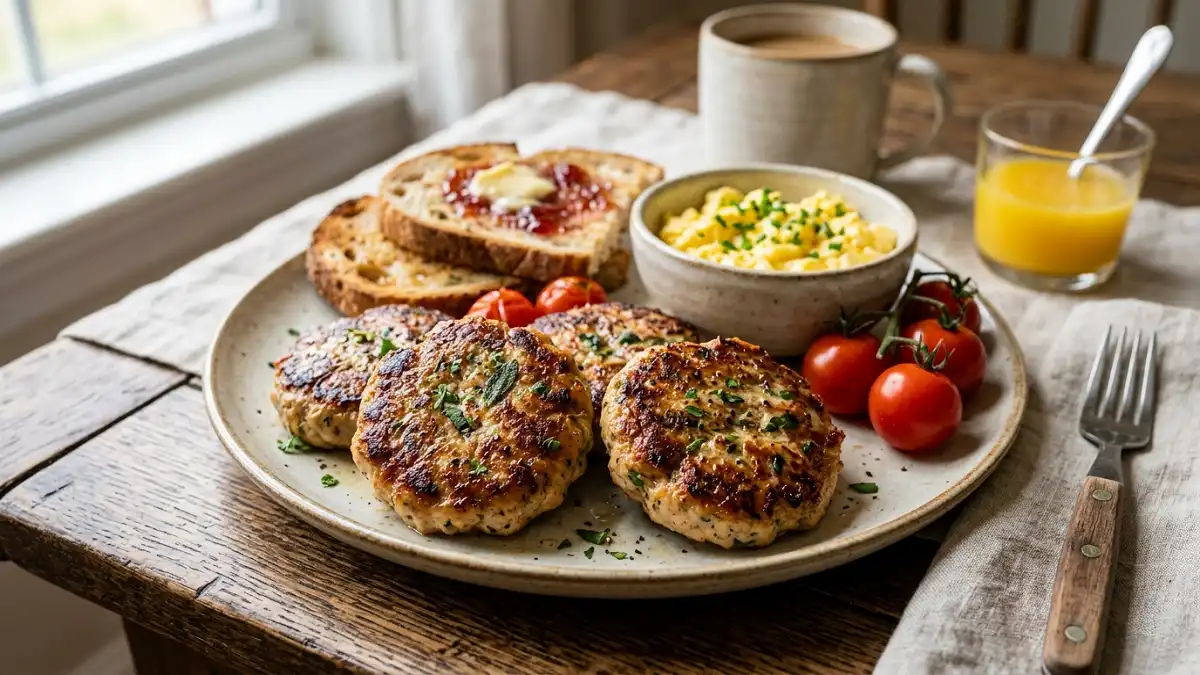
Chicken Sausage Patties: Build Better Breakfast Meat
Chicken sausage patties are quietly replacing pork at the breakfast table, and the shift is accelerating fast.
Home cooks and food-conscious families are demanding leaner, cleaner morning protein without sacrificing flavor or satisfaction.
Our culinary team has been testing, seasoning, and pressing patties for weeks — and we are ready to share everything we learned.
Ground Beef and Sweet Potato Skillet Done Right
Key Takeaways
- Chicken sausage patties deliver significantly less saturated fat than traditional pork breakfast sausage while maintaining serious flavor when seasoned correctly.
- The fat-to-meat ratio in your ground chicken blend is the single most important variable in achieving a juicy, non-rubbery patty.
- Fresh herbs and a touch of maple or fennel seed are what separate a memorable patty from a forgettable one.
Why Are Chicken Sausage Patties Having a Moment Right Now?
If you’ve been following natural food trends this year, this won’t come as a surprise.
Consumers are reading labels more carefully, and the saturated fat content in conventional pork sausage is pushing health-aware households toward poultry-based alternatives.
Chicken sausage patties land right at the intersection of that demand.
Our culinary team observed that this shift is not just driven by health metrics alone.
Flavor expectations have risen dramatically.
People are no longer willing to accept a bland, dry chicken patty as a trade-off for eating cleaner.
The good news is that with the right technique, you absolutely do not have to.
What Does This Mean for Natural Food Lovers?
Culinary insiders are noting a clear pattern: the best chicken sausage patties on the market — and in home kitchens — are built with ground chicken thighs, not breast meat alone.
Thigh meat carries more natural fat, which means better browning, better moisture retention, and far more flavor in the finished patty.

Our harvest analysis suggests that sourcing ground chicken from free-range or pasture-raised birds produces a noticeably richer result.
The feed and lifestyle of the bird directly affects the depth of flavor in the meat, and that truth shows up clearly in a simple pan-seared patty.
Dairy Free Cookies: Elevate Your Farm Baking
How Does the Nutrition Actually Stack Up?
| Nutrient | Chicken Sausage Patty | Pork Breakfast Sausage | % Difference |
|---|---|---|---|
| Calories | 160 | 210 | -24% |
| Protein | 18g | 14g | +29% |
| Total Fat | 8g | 16g | -50% |
| Saturated Fat | 2g | 6g | -67% |
| Sodium | 380mg | 420mg | -10% |
| Iron | 1.2mg | 0.9mg | +33% |
Values are per 2-patty serving, approximately 85g total.
Figures based on free-range ground chicken thigh blend versus conventional pork sausage.
What Ingredients Actually Make the Difference?
Flavor Profile Breakdown
- Savory base: Ground chicken thighs, garlic powder, onion powder
- Herbal lift: Fresh sage, fresh thyme, dried fennel seed
- Warmth and depth: Smoked paprika, black pepper, a pinch of cayenne
- Binding and moisture: One egg yolk per pound of meat, one tablespoon of cold water
- Optional sweetness: 1 teaspoon of pure maple syrup for a breakfast-forward profile
Our culinary team tested six seasoning combinations before landing on this balance.
Fennel seed is the ingredient most home cooks underestimate — it is what gives chicken sausage patties that familiar, satisfying sausage character without using pork.
Step-by-Step: How to Make Chicken Sausage Patties at Home
Ingredients
- 1 lb ground chicken thighs (or 80% thigh, 20% breast blend)
- 1 tsp garlic powder
- 1 tsp onion powder
- 1 tsp fennel seed, lightly crushed
- 1/2 tsp smoked paprika
- 1/2 tsp dried sage or 1 tsp fresh sage, finely chopped
- 1/2 tsp fresh thyme leaves
- 1/4 tsp cayenne pepper
- 3/4 tsp fine sea salt
- 1/2 tsp cracked black pepper
- 1 egg yolk
- 1 tbsp ice-cold water
- 1 tsp pure maple syrup (optional but recommended)
- 1 tbsp neutral oil for cooking
Spaghetti Sauce Recipe With Real Tomatoes That Delivers
Instructions
Step 1 — Mix the Seasoning Blend First
Combine all dry spices — garlic powder, onion powder, fennel seed, paprika, sage, thyme, cayenne, salt, and pepper — in a small bowl.
Mixing your seasoning separately before adding to the meat ensures even distribution throughout every patty.
Step 2 — Combine the Meat Mixture
Place ground chicken in a large mixing bowl.
Add the seasoning blend, egg yolk, cold water, and maple syrup if using.
Mix with your hands until just combined — overworking the mixture will produce a tough, dense patty.
Step 3 — Portion and Shape
Divide the mixture into 6 equal portions, approximately 75g each.
Press each portion into a flat, even disc about 3/4 inch thick.
Slightly wider is better here, as chicken sausage patties will shrink during cooking.
Step 4 — Chill Before Cooking
Place shaped patties on a parchment-lined tray and refrigerate for 20 minutes.
This step is not optional — chilling firms the patty and dramatically improves how it holds together in the pan.
Step 5 — Sear with Intention
Heat oil in a cast-iron or stainless skillet over medium heat until shimmering.
Add patties without crowding the pan and cook for 4 minutes undisturbed on the first side.
Flip once and cook for a further 3 to 4 minutes until internal temperature reaches 165°F (74°C).
Step 6 — Rest, Then Serve
Remove chicken sausage patties from the pan and rest on a wire rack for 2 minutes.
This allows juices to redistribute through the patty rather than running out the moment you cut in.
Cook Spaghetti Squash in Oven the Right Way

How Will This Recipe Change Your Weekly Meal Prep?
Chicken sausage patties are one of the most practical proteins you can keep on hand.
They freeze beautifully — stack them between parchment sheets and store for up to 3 months.
Reheat directly from frozen in a covered skillet over low heat for 6 to 7 minutes, or in a 350°F oven for 10 minutes.
Our culinary team relies on a double batch every Sunday to cover fast weekday breakfasts without reaching for processed, packaged options.
Chicken sausage patties made at home with quality ingredients will always outperform anything in a commercial freezer bag.
Make the batch. You will not go back.